Before Broadway, Before Shakespeare: Paphos's 2,000-Year Love Affair with the Stage
When the house lights dim at a Paphos Theatre production, you're not just settling in for a show. You're participating in a tradition that stretches back over two millennia — to a time when this island was a stopping point for traveling performers, when audiences climbed stone terraces to watch tragedy and comedy under the Mediterranean sun, and when the god of theatre himself, Dionysus, was said to walk these shores.
For American travelers who think of Cyprus as a beach destination, this is the plot twist: you're standing on one of the oldest theatrical landscapes in the world.
The Greeks Invented the Standing Ovation
Theatre as we know it — actors, a stage, an audience gathered to watch a story unfold — was born in ancient Greece. And Cyprus, sitting at the crossroads of the Aegean and the Levant, absorbed that tradition early and thoroughly.
The island's connection to Dionysus runs deep. The god of wine, fertility, and — crucially — theatre was worshipped here for centuries, and dramatic performances were originally part of religious festivals held in his honor. When you watch a play in Paphos today, you're echoing rituals that began as offerings to a god.
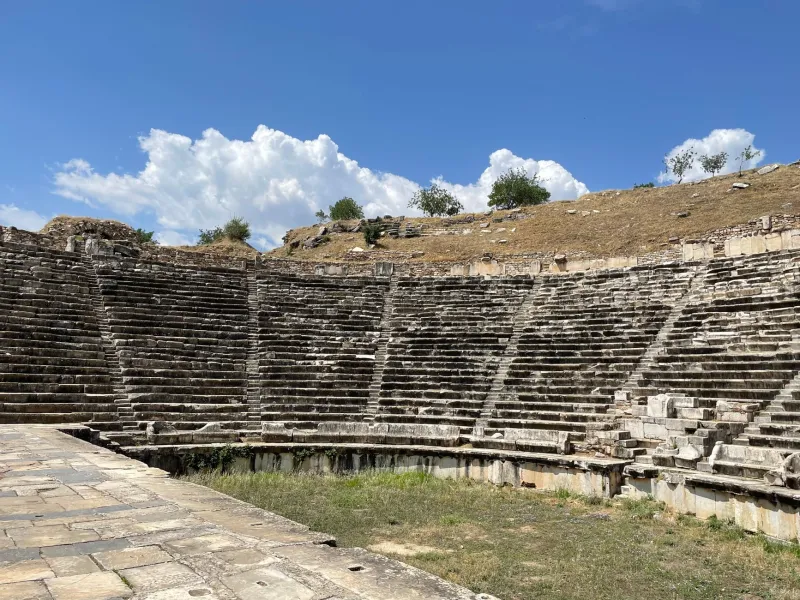
The physical evidence is all around you. Cyprus is dotted with the remains of ancient theatres, carved into hillsides so that every seat had a view — and, cleverly, so the hillside itself acted as natural acoustics. The most famous example on the island is the great theatre at Kourion, just down the coast from Paphos: a stunning semi-circular amphitheatre built in the 2nd century BC, still used for performances today. Sitting on those stones, you realize the Greeks understood sightlines and sound design better than most modern venues.
In Paphos itself, the Archaeological Park and the Odeon — a small Roman-era theatre built into the landscape — offer a tangible link between the island's ancient stagecraft and its living tradition. The Odeon still hosts summer performances, which means you can watch a play in a structure that has been hosting plays, in one form or another, for the better part of two thousand years.
From Amphitheatre to Community Stage
So what happened between antiquity and today? The short version: everything. Empires rose and fell, the island passed through Byzantine, Venetian, and Ottoman hands, and formal theatre waxed and waned. But the instinct to gather and perform never left.
Modern Cypriot theatre took shape in the 20th century, and community stages like Paphos Theatre carry that torch at the local level — an all-volunteer-and-neighborhood-energy scene where teachers, retirees, and students share a stage. In a way, that's closer to the ancient model than Broadway ever was: theatre as a civic event, owned by the whole town, where the audience and the performers are often the same people on different nights.
Honoring the Classics — and Messing with Them
Here's what makes the modern scene genuinely interesting rather than merely historic: Paphos productions don't treat the classics like museum pieces.
Yes, you'll find Greek tragedy on the calendar — Euripides and Sophocles still pack a house, and hearing those lines spoken within sight of the sea they were written near hits differently than in a university lecture hall. But local directors love to reinvent. Ancient myths get modern settings. Comedies get updated with contemporary Cypriot humor. Some productions blend Greek text with English surtitles, making them surprisingly accessible even if your ancient Greek is a little rusty (ours too).
That spirit of reinvention is itself an ancient tradition. The Greeks were remixing myths for centuries — every playwright who staged the Trojan War put his own spin on it. Today's Paphos productions are just the latest verse in a very long song.
Planning a Heritage-Themed Theatre Trip
If you're the kind of American traveler who plans vacations around history — the Colonial Williamsburg type, the Acropolis-at-dawn type — here's how to build a theatre pilgrimage into a Cyprus itinerary:
- Day one: Paphos Archaeological Park. Wander the ruins, including the Odeon, and imagine the performances these stones once held. Go early; the mosaics alone are worth the trip.
- Day two or three: Catch a live show at Paphos Theatre. Check the season calendar before you book flights — summer offers the fullest schedule, often with open-air staging.
- Side trip: Kourion. A short drive from Paphos, this clifftop amphitheatre is one of the most spectacular ancient sites in the Mediterranean, full stop. If there's a performance scheduled during your visit, go. Watching live drama in a 2,000-year-old venue is a bucket-list item most Americans don't even know to put on their list.
Why It Matters
Theatre is one of those art forms that connects you directly to the people who came before. The tools have changed — electric lights instead of oil lamps, printed programs instead of word of mouth — but the essential act is identical: a community gathering to watch itself reflected on a stage.
In Paphos, that act has been repeated for over two thousand years. All you have to do is buy a ticket and join the audience.